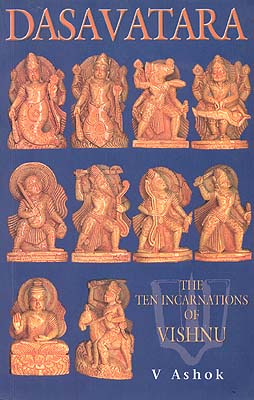
 Practice in Dark Times: Kali Yuga and the Bhagavad Gita
Meredith W. Watts (Draft July 2014)
NOTE: This was prepared to support a discussion project with a group of practitioners of various spiritual backgrounds. It may have a superficial look of scholarship, but it is really nothing more than an attempt to find some of the interesting questions that practitioners might wish to consider. The many infelicities and arguable interpretations that may follow are part of that discussion. Though there are many errors in interpretation that I would happily attribute to others, unfortunately the errors are my own.].
This material is currently posted on http://www.meredithwwatts.com/yogablog. The blog was originally designed to share class and discussion materials with students others. It is not set up as a forum, but I would welcome comments at mw@meredithwwatts.com. Other personal material appears on my root website http://www.meredithwwatts.com]
Introduction
The Atomic Bomb and J. Robert Oppenheimer: The Bhagavad Gita and Krishna in
Popular American Culture
Is Cosmology Necessary?
Elements of Kali Yuga in the Mahabharata and Bhagavad Gita
Kali Yuga and Cycles of Creation
The Chronology of Eras and Cycles: The Days and Nights of Brahma
Evils of Kali Yuga
Kali Yuga and Cultural Fundamentalism
Western Yoga and Hindu Cosmology
What Do We Do as Practitioners?
APPENDIX: The Trimurti and the Ten Avatars of Vishnu
NOTES
Introduction
This first section will try to get a bit of order into what began as a simple investigation of the notion of Kali Yuga, the period of darkness and spiritual decadence in the Hindu cosmology of cycles and divine interventions. Since this period includes all of current and remembered human history, and much more than any of us will experience, it is a description of a human world whose virtues are tottering and individual spiritual progress is both vital and difficult. Throughout this discussion I am not interested in theology, metaphysics, or what sometimes gets called “comparative religion” in the school curriculum. I am mostly interested here in the structure of mythopoetry, the broader spiritual matrix of which yoga is a specialized part, and, finally, what meaning this may mean for a normal practitioner of yoga. There are what might be called archetypes of belief, structures of thought related to creation, maintenance and destruction, describing evolution and progress, placing individual spiritual growth in the world of challenges, and divine intervention (not seen, but imagined) when all else fails.
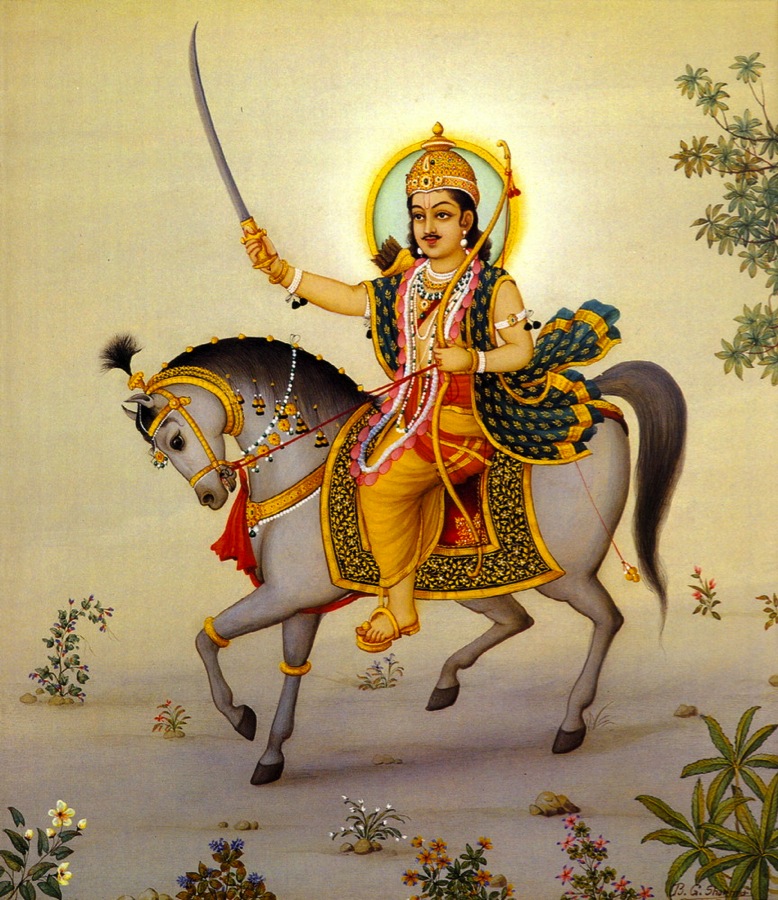
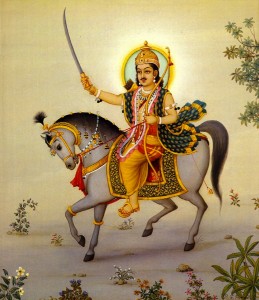
An underlying theme is the question of whether history, and the evolution human consciousness is linear (ascending or descending), or cyclical, or some combination of both transformations. The golden age of natural virtue is postulated in the past; the golden age to come follows a cataclysm of violence brought by a divine avenger. At key points in this cosmic history the figure of Vishnu appears in various avatars of material manifestations (see Appendix). Each reincarnation is a higher-level being from fish (the first, Matsyendra) to the virtuous king Rama, the philosophical teacher Krishna, the spiritual person of Buddha (yes, the tradition claims him also, though a bit ambiguously). Finally Kalki Avatar, the avenger who (apparently tiring of the failings of moral society) appears with a white horse and sword to sort things out. The sweep is from creation to cleansing fire, with the gradual evolution of humans following a halting path –- path that is currently one of decadence and loss.
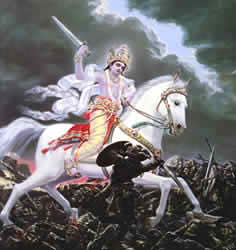
Figure 1 Kalki Avatar
This discussion all began innocently enough in discussions about the efficacy of individual spiritual practice, whether in yoga or other traditions. How is the individual to practice in hard times (that is, nearly all the time), and what belief of redemption or enlightenment supports the practice? In a way, these are “structural” problems in spiritual thinking that ground individual practice in a broader supporting matrix of belief about society, other beings, and forms of mundane or sacred transcendence.
There are scarcely limits on this sort of discourse, but certain central issues recur – one is the possibility of ascending cycles of human and social consciousness. Its alternative is a darker view of cycles of morality and decay. This latter perspective is often accompanied by prescriptions of moral practice for individuals in their imperfect worlds, finding ways to maintain spiritual progress individually or in groups. An element that may accompany either but seems more often to accompany the latter, is a messianic view of divine intervention that “sweeps the world clean” of decadence and makes the world new again.
There are many variations, some in which individual spiritual consciousness is progressively shared in a process that produces a general chance in social consciousness. In others, the darkness is not banished by all the small candles lit by individual spiritual practice, but requires some form of divine intervention. As theologians and historians suggest, this is usually understood as the result of three processes: An individual is born of the union of a divine being with a mortal (common in Greek mythology), an exceptional individual is “exalted” from human to divine status by teaching great virtue, or an already divine entity appears on earth to intervene. (1) This is a story of the third type: The god Vishnu appears as Krishna, chariot driver to the warrior to Arjuna, to teach him duty and service. This is why Krishna/Vishnu is there at that time; knowing this is critical to understanding the darkness of current human society and the various forms Vishnu takes to restore the world (as Buddha, for example).
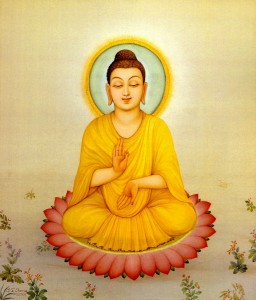
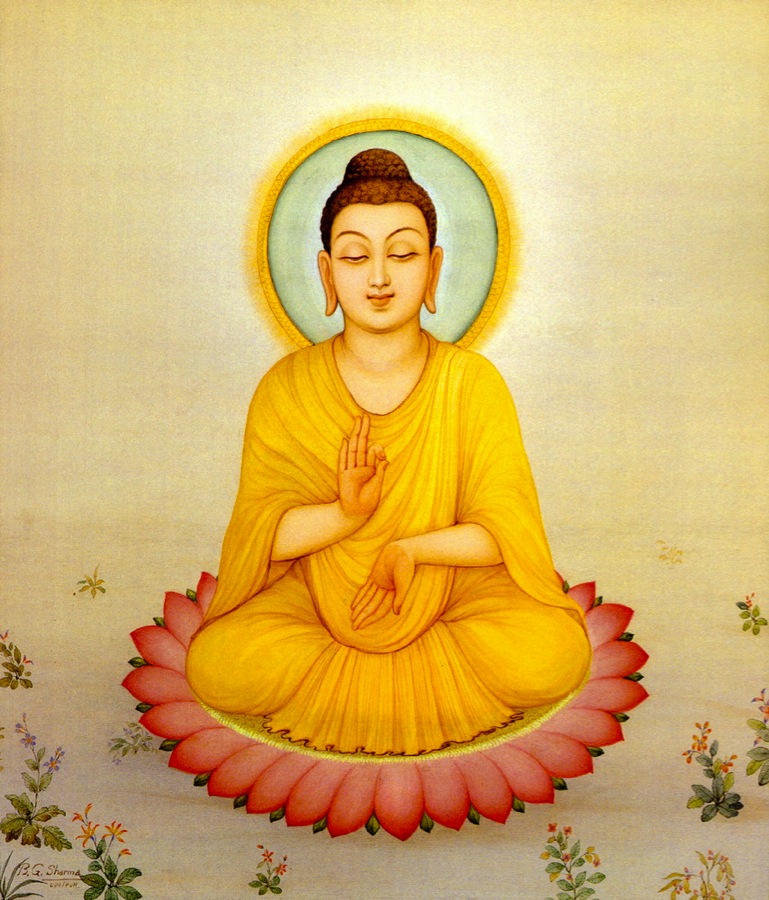
Figure 2 Buddha ( 9th Avatar of Krishna, in the Brahmin tradition)
The latter incarnations are associated with great poetry: The Ramayana describes the struggles of king Rama; the Bhagavad Gita the details the spiritual teachings of Krishna; the Buddha Dharma a special path of spiritual vision; and finally the cataclysmic vision of Kalki Avatar restores virtue through destruction. It is the Bhagavad Gita – portions of it, at least – that I draw on here. It contains the teachings of Krishna/Vishnu, not coincidentally at the end of a third major world epoch marked by the departure of Krishna and decline into darkness. It is this portion of the cosmology that brings us, oddly enough, to the atomic bomb. Though the Bhagavad Gita has been long known in the United States, and particularly loved by Thoreau and early liberal thinkers, it entered American popular culture dramatically in the reflections of J. Robert Oppenheimer after the detonation of the first atomic bomb.(2)
The Atomic Bomb and J. Robert Oppenheimer: The Bhagavad Gita enters Popular American Culture
A contemporary detour in this discussion comes from the cultural confluence of ancient messianism and the development of the atomic bomb in the Trinity project directed in the 1940’s by J. Robert Oppenheimer. I’ll start there because it unexpectedly brings us back to the question of cycles of moral history, the mythochronology of the universe, cosmology, and the Indian spiritual poem the Bhagavad Gita (“Song of God). It also involves a bit of textual exegesis (for which I apologize), but eventually it comes back to individual practice and the initial question of spiritual progress.
To begin, I have always been a bit mystified that the best-known citation of the Bhagavad Gita in recent American history never actually appears – at least not as it is usually portrayed. This may count as the most important quotation from the Gita that was never written. It comes from the fact that Oppenheimer taught himself Sanskrit (“it was easy,” he said) and read the Bhagavad Gita in the original. His references therefore were not from any traditional or canonical translation (there are many), but from his own recollections and the meaning he attributed to key passages. This was the case in his reference to the atomic bomb.
Oppenheimer famously said – though in various versions – that the first nuclear explosion reminded him of the phrase “I am become death, the destroyer of world.” Elsewhere it is cited as “I am become Death, the shatterer of worlds (see Hijiya, 200). A historian of the period cites the Bhagavad Passage
If the radiance of a thousand suns
Were to burst into the sky
That would be like the spender of the Mighty One —
Though this passage is the more customary translation of the original, it is the “shatterer of worlds” that has stuck in the American consciousness. As appropriate as it may be for the destructive potential of the atomic bomb, the passage actually occurs as a description of the Hindu god Vishnu when he reveals his true nature to the warrior Arjuna in the Bhagavad Gita. He is the “Mighty One” who reappears in various avatars during cosmic and earthy history, but whose essence is glimpsed only as “the radiance of a thousand suns.” Arjuna has asked to be shown the true nature of God, not death and destruction.
At the risk of compounding this bibliophilia, it is important to note that all translations of the Gita carry with them the cultural perspective of the translator. Renderings that are closer to the original terminology and cultural matrix are full of terms like dharma and maya. Such terms are multisymbolic and ambiguous even in the in original Sanskrit, and can only be made available to Western readers through discursive definition. Translators from, say, a Christian tradition are more likely to use terms like “Lord,” “God,” and “soul” in a manner that communicates with some Western tradition, but slips away from the original cultural matrix somewhat. This translation problem is as much conceptual as it is linguistic. And that was the case with the famous Oppenheimer quote. To make things worse, the key word is kala which can mean either “death” or “time.” This gives us Krishna’s words as translated by Juan Mascaró;
I am all-powerful Time which destroys all things, and I have come here to slay these men. Even if thou dost not fight, all the warriors facing thee shall die.” (11:32).
This carries a central teaching about the battle facing Arjuna: Even though he is reluctant to go into battle and causing death to his opponents, Time (or Death) will take them anyway. Cosmically, perhaps, it does not matter if Arjuna hastens the process by doing his duty as a soldier. In any event, Time or Death do not appear as the “shatterer of worlds.”
This meaning is still problematic for many Western readers such as Thoreau, who appreciated the Bhagavad Gita’s lessons of self-liberation and service, but objected morally if that service was in the study of war. The same is true here, as Hijaya argues in his article “The Gita of J. Robert Oppenheimer” (Hijiya, 2000). The greatest offense of all, Hijaya argues, is that Oppenheimer may have “done his duty” and excused himself for the consequences of the bomb whose development he led. This interpretation may seem to be a bit stretched, particularly coming from philosopher with no particular background in Sanskrit or Hindu cosmology, but it does point to a difficulty Westerners have in interpreting Eastern concepts.
Putting these thoughts together, we have the following translation from Easwaran with the preceding imprecation from Arjuna, who is actually asking God to reveal himself:
ARJUNA
Tell me who you are, O Lord of terrible form. I bow before you; have mercy! I want to know who you are, you who existed before all creation. Your nature and workings confound me (11:31)
KRISHNA
I am time, the destroyer of all; I have come to consume the world. Even without your participation, all the warriors gathered here will die (11:32)
Therefore arise, Arjuna; conquer your enemies and enjoy the glory of sovereignty. I have already slain all these warriors; you will only be my instrument (11:33)
As in the Moscaró translation, kala is rendered as time, not death. But translation issues aside, it is in these poetic ambiguities that the Gita, and Oppenheimer, may appear to be justifying destruction. Arguably, Oppenheimer did his duty by hastening the mass destruction of the atomic bomb, being its instrument in the course of inevitable Death or Time.
But this leaves an important point: What is Krishna, as an avatar or incarnation of the god Vishnu, doing there in the first place? This is the question of Hindu cosmology and the foundation of its mythochronology. (3) This is the matter of Kali Yuga and the cycles of time for all the worlds, the earth, humankind, and time itself. The answer is as awe-inspiring and exalted as might be imagined: Vishnu has been here seven times before to save the world, and he will return twice more. As Krishna he teaches the path to duty and enlightenment. He comes again as Buddha to teach the culmination of spiritual growth. Lastly, even though individuals may reach enlightenment, the moral collapse around them brings Vishnu once again as Kalki Avatar, the avenging warrior who destroys evil and cleanses the world (Appendix). In between is Kali Yuga, the age in which we now live – and, in fact, in which all human kind in memory has lived.
Is Cosmology Necessary?
Hindu cosmology is normally not important to the normal Western practitioner of hatha (physical) yoga, but it may become relevant when the physical practice is enriched with a reading of the Bhagavad Gita (or the Mahabharata of which it is part). In the Gita the figure of Krishna appears as an avatar of the god Vishnu to counsel the warrior Arjuna in his internecine struggle for power with his vast family at the battle of Kurukshetra.
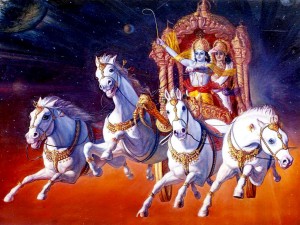
Figure 3 Krishna Avatar in the Bhagavad Gita (4)
The battle has historical roots, but also a mythical component. A common agreement places the actual battle at around 3102 B.C.E, after which Krishna leaves the earth and the beginning of Kali Yuga begins. In the legend Vishnu appears once again to restore moral order – this time as the avatar Kalki. In this warrior form he destroys heretics and barbarians (Mleccas) to restore a new Golden Age. In other words, Bhagavad Gita, perhaps the most widely known spiritual poem in world literature, is embedded in this ancient cosmology. (5)
This entanglement of yoga and Indian spiritual belief helps explain the periodic controversies between Westernized yoga practitioners (who often treat physical yoga as a branch of gymnastics or advanced stretching) and spiritual critics from the Hindu tradition, who object to divorcing yoga from its origins in Hindu religion. Somewhere in between are yoga practitioners who adopt some aspects of the Hindu spiritual matrix to their own study, including chants, mantras, and other practices. For those practitioners, the leap to this form of metaphysical Vishnaivism is usually a step too far; however, this discussion is simply a link to that broader world in which some ancient yoga is anchored.
The Hindu cosmology of world eons is a vast cyclic theory that encompasses billions of years, endless repeating itself through creation, growth, decline and destruction. There are cycles within cycles, with periods of light and optimism within even the darkest era. This vast cosmology sees both darkness and light in perpetual cyclic motion. This is unlike the Western philosophic and religious traditions that often refer to master narratives of cosmic creation and evolution to a higher moral order. These Western narratives share the salvationist sense of savior figures that appear to create a new moral order. There are there are narratives of challenge, crisis, decline, destruction and rebirth. In general, these conceptions (like that of Vishnu/Krishna/Kalki), invoke an outside figure as the bearer of salvation. They take on the sins of their chosen people, punish the sinful, give a new moral code, and give a promise of a hereafter in which the good are rewarded. A Golden Age can be attained in a heaven, even if not on earth. In Hindu cosmology, the Golden Age is reinstated on earth and available to all (who survive the moral fire of Kalki).
There are also narratives in Western spiritual thought that describe an optimistic progressive evolution of consciousness and morality. These typically are not brought by godlike moral agents from outside, but can be reached through the evolution of consciousness and morality by normal people or communities of practitioners. Some theories even project a natural evolution toward higher collective states of consciousness – a joint human evolution toward a Golden Age that we create ourselves. The theory of Kali Yuga is not like that.
Within a particular eon there may be cycles of progress and morality. These periods may be thousands of human years long, so in fact might be compatible with some Western theories. For example, the Christian narrative is only about 25 centuries old, short by Hindu cosmic standards. It could easily fit in a period of the current dark era.
Some believe that the notion of Kalki may have even been influenced by milleniarism of Christianity, but that is not an important question here. What remains is that the Hindu cosmology contains a millenarian period with an avenging savior who brings an end to darkness — coming not a first or second time as savior, but a total of 10 times.
Salvation is not permanent though. “Time and this historical process are parts of a vast cyclical movement, but not, as some cyclical versions of history, a simple cycle of birth, growth, death and then rebirth of a repetition of the past. “ Instead, it is a vast set of concentric circles moving through billions of years of human time (Embree, p. 220.).
A new cycle begins with a Golden Era of morality (another Krita Yuga), only to fall into decline again. For the cosmically-minded, the Christian narrative is only a brief story that easily fits into one of the smaller pockets of the billion-year Hindu narrative. Tut trying to resolve cosmic chronologies may not be a satisfying exercise here, but religiously-oriented theorists and scientists are attempting to do so. Archeologists are brought into the story in the study of ancient, submerged cities (e.g., Davarka), and there are Bahai and Aquarian versions that place the contemporary age in the period of ascension rather than decline.
Elements of Kali Yuga in the Mahabharata and Bhagavad Gita
The battle of the Pandavas and Kauravas may, like the Iliad, be based on actual events. The legendary date is placed at 3102 B.C.E. This date coincides roughly with the beginning of Kali Yuga and more or less with Krishna’s departure from the material world. Easwaran (p. 3ff) suggests that the actual battle may have occurred sometime between 1000 and 799 B.C.E. Others date it sometime between 1000 to 2000 B.C.E.(6)
In broader social terms the period seems to correspond to migrations and settlement patterns centuries before the Mahabharata was actually written. Aryan tribes from the Caucasus invaded from the north and imposed a martial discipline on the population. They brought with them the prototype of the Sanskrit language and many elements of belief and culture that became part of Hindu tradition (Easwaran). Linguistically they were the Bharatas. The title of the poem is composed of “Maha,” meaning “great,” and “Bharata,” a term used for the Aryans. It is not always clear whether the writers of the puranas saw the Aryans as the Mlecchas (barbarians), or understood them as protectors from other invading barbarians. According to Buck, the legend tells of the Bharata war between the Pandavas (or Pandus) against the Kauravas on the plain of the Kurus (Kurukshetra) in the fertile land at the confluence of the Yamuna and Ganges rivers near today’s Delhi. Though India was diverse, the most important area according to historians was the Bharata, the land of the Aryans in the north of India – south of the Himalayas and north of the Vindhya Mountains, and bounded by the desert in the west and Bengal swamps in the east (Buck xx).
It is not necessary to adopt the literal cosmology of Kali Yuga to appreciate the spiritual message that is associated with it. The mythopoetic elements of the story are basic to the metaphorical and spiritual foundations of yoga (along with the Sutras of Patanjali and other specialized texts such as the 14th century Hatha Yoga Pradipika). These texts adopt a view of “yoga” that is not restricted to various cleansing practices (kriyas), postures (asanas), and breath work (pranayama) as known in hatha yoga, but refer more broadly to practices leading to spiritual enlightenment. There is also reference, though not necessarily by contemporary terminology to the modal yoga paths of karma yoga (action), jñana yoga (meditation and study), and bhakti yoga (devotion). In the Bhagavad Gita the spiritual teaching is directed ostensibly to the warrior Arjuna and describes in detail the “karma yoga” of action (acting responsibility, “doing your duty” without attachment to the consequences).
In this spiritual tradition, the god Vishnu is the sustainer of the universe. He manifests in material form at times of crisis to help humankind. In the Bhagavad Gita he assumes human form as the avatar Krishna. He appears to Arjuna, the warrior and leader of the army of the Pandavas to fight his kin, the Kauravas, at the battle of Kurukshetra. Krishna offers spiritual instruction to Arjuna just before the battle by explaining to him the nature of his path (dharma) and his obligation for action. The encounter is part of Mahabharata, but is normally presented separately. It forms an integral part of the philosophical and spiritual tradition of yoga.
The field of battle, Kurukshetra, takes its name from Kuru, the family of whom the combatants on both sides are members, and shetra, the Sanskrit word for “field.” It is believed to be based on actual events, but it is much more than a history. The battle field is also understood to be a metaphor for the struggle between good and evil in the world, and the struggle within each individual between baser and more spiritual elements.
The epic poem was recounted by the sage Vyasa, dictated according to legend to the half-elephant god Ganesha who wrote it down using his broken tusk as a pen.
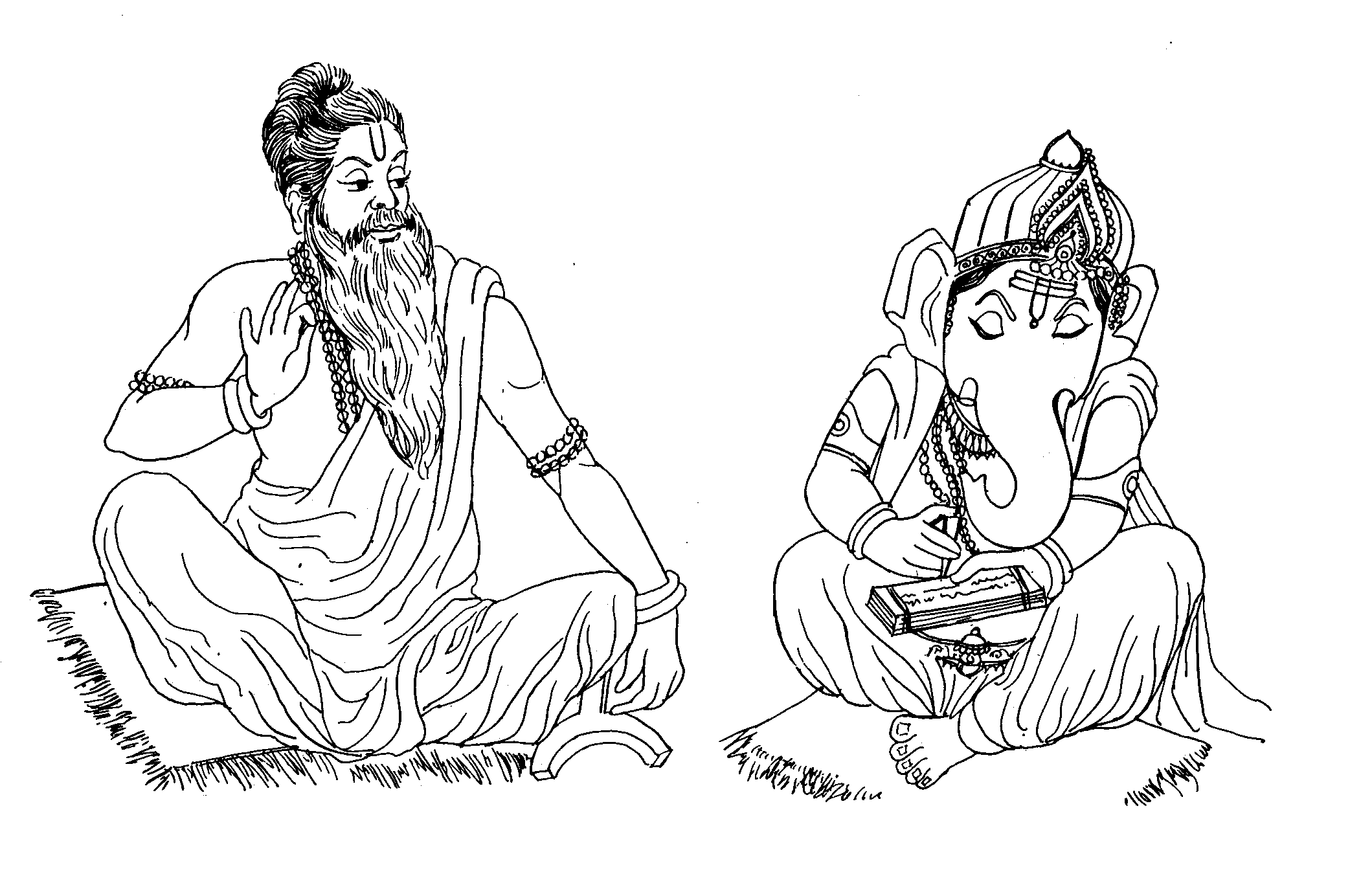
Figure 4 Stylized Image of Vyasa Dictating the Mahabharata to Ganesha
History, myth, cosmology, and metaphysics are combined in this narrative of spiritual struggle which takes place at a turning point in the material world – symbolically, the battle of Kurukshetra where good and evil (actually, or metaphorically within each of us) is waged. At this junction of myth, history, and spiritual development, Vishnu manifests as Krishna, chariot driver and mentor for Arjuna (if you imagine this treatment in a modern film, it would be like a modern military leader finding that his helicopter was actually God, with a message for him).
In legend this is his eighth incarnation (see Appendix) and his final appearance in material form before the beginning of the Kali Yuga. Krishna tells Arjuna of his return as an avatar and offers the promise that he will return to material form when he is needed.
Vishnu/Krishna pledges his power to sustain the human world by saying:
My true being is unborn and changeless.
I am the Lord who dwells in every creature.
Through the power of my own maya, I
Manifest myself in a finite form.
Whenever dharma declines and the purpose of life is forgotten,
I manifest myself on earth.
I am born in every age to protect the good, to destroy evil, and to re-establish dharma.
(Easwaran, Discourse/Chapter 4, p. 86)
The word maya often refers to the material world of illusion and impermanence, but here it refers to the power of a god to appear in material form. Dharma also has multiple meanings but seems here to refer generally to the spiritual path. (7) He announces that, like a boddhisatva in Mahayana Buddhism, he remains in the material world to help humankind. Yet, he differs from the Buddhist boddhisatva in that he is a personified god who takes specific forms during crucial struggles with demons and humans. In one manifestation Krishnu appears in a 9th incarnation as the Buddha. Modern ecumenical Hindu interpretations take this as a spiritual evolution, but Doniger’s translation of older secular texts (puranas) also show an anti-Buddhist sentiment according to which Buddhism is an spiritual step to be transcended when Krishna comes back as Kalki (see Appendix).
Figure 5 Classic Image of Kalki Avatar
Kali Yuga and Cycles of Creation
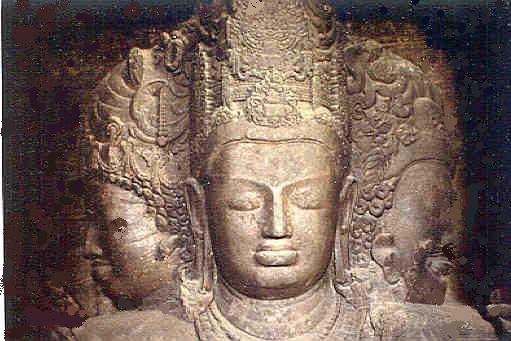
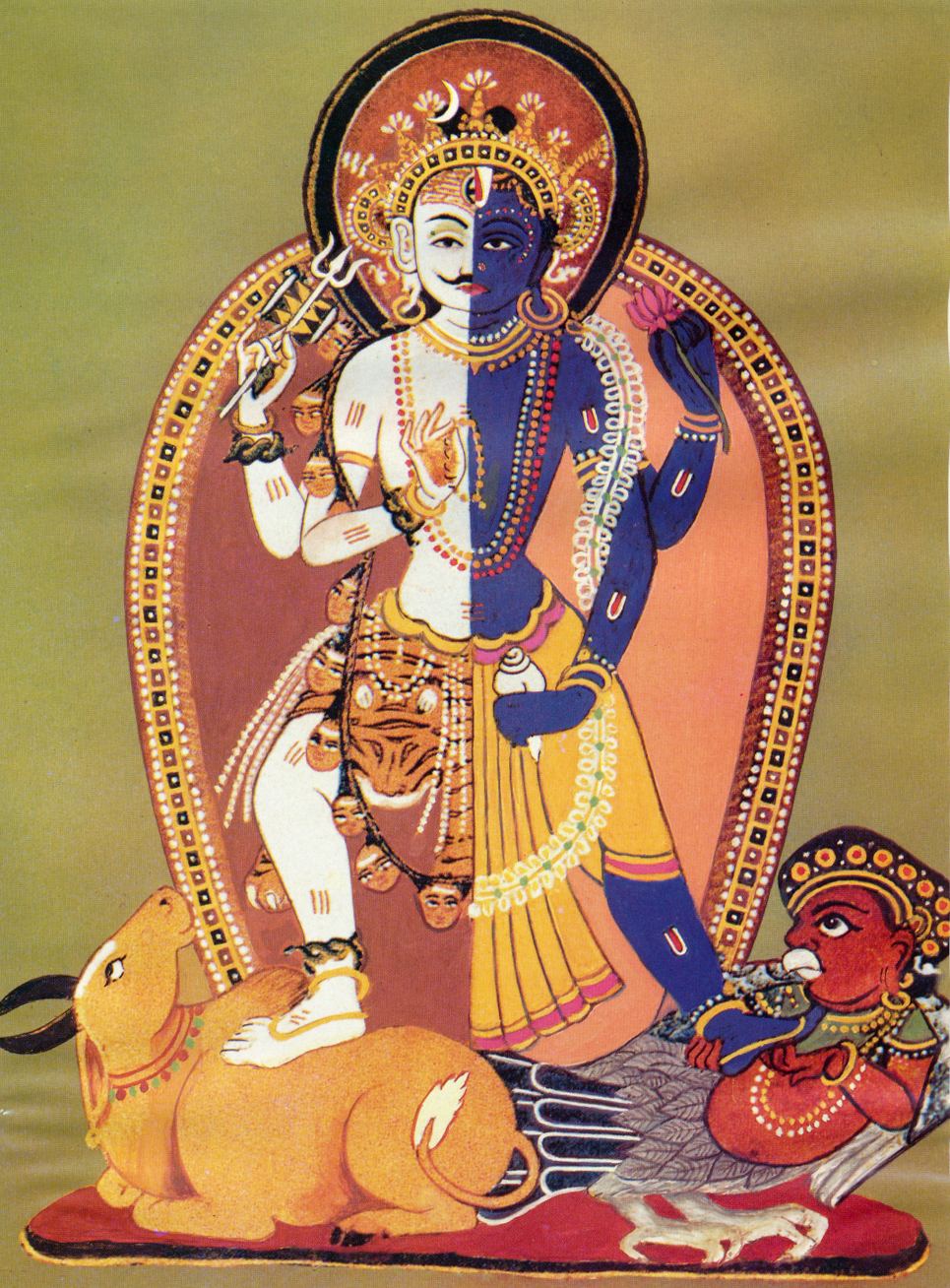
The notion of Kali Yuga is embedded in a cosmology of cycles within cycles, all related to the days and years of the gods (or of Brahma) whose sleeping and waking governs the cycles of human history. Brahma is the creator god. Earth, once created, is sustained by Vishnu. Shiva, the lord of dance and of yoga, is also the destroyer god. This trinitarian god, iconically represented in the composite image of the Trimurti, governs earthly cycles of founding/creation, growth, cultural and spiritual growth, critical events, decline, times of darkness, revenge/redemption, and rebirth. In the Vishnaivite metaphysics of the Bhaghavad Gita, This triumvirate is wrapped into the single figure of Vishnu, here manifested as Krishna. In the same way the leading descriptions of Kali Yuga come from the Vishnu Puranas which also place Vishnu at the center of creation, sustenance and destruction (focusing in him the powers that other Hindu traditions may give to Brahma and Shiva).
However, in the broadest historical sense, these cycles do not form a linear progression in one direction or another. They are characterized by a historical decline from a Golden Age to the fall into the moral darkness of Kali Yuga. The transformation to a better cycle is punctuated by the appearance of Krishna who restores darkness to light.
The vastness of this cosmology cannot be reduced to a simple notion of creation, decline and restoration/recreation, however. The cycles are so long that there are multiple cycles within them in which morality may grow and decline. This might be vaguely like the way economists distinguish between long-term trends and short-term cycles, perhaps more on the cosmic time scale, the cycle of earth’s seasons which occur within the long-cycle of creation and eventual cooling of the sun or earth. The interwoven cosmic scale produces an elaborate astrology and metaphysics devoted to the question about which cycle now governs human life on earth. I have taken here the common and necessarily superficial interpretation that humankind has been in Kali Yuga, the time of darkness and spiritual decadence, for thousands of years. In what appears to be the most orthodox interpretation, human history is in long-term decline, perhaps relieved by periods of short-term improvement but headed toward an apocalyptic redemption through violence and destruction.
This is not a theory of the successive evolution of consciousness and virtue; it is an image of cyclical change from a golden age to a critical event (Krishna leaving the material world). He returns when it has gotten bad enough. Human time is a long succession of eons in which there are periods of varying virtue. The succession is not from lower to higher periods, but of decadence from higher to lower. A cataclysm brings the dark period to an end and begins a new Golden Age (Krita Yuga) as the cycle again.
The Chronology of Eras and Cycles: The Days and Nights of Brahma
The vast sweep of this vision is difficult to comprehend without some basic “metrics” of scale that put it more or less in human terms. Even then the time span is mind-boggling. It is also not undisputed among Hindu traditions; however, I have tried to reconstruct a generally accepted chronology from various sources (particularly including Embree, Hindu Myths…).
In the Bhagavad Gita Krishna affirms to Arjuna that in the vast scale of time all will ultimately return to him (Vishnu as god):
Those who understand the cosmic laws know that the Day of Brahma ends after a thousand yugas and the Night of Brahma ends after a thousand yugas. When the day of Brahma dawns, forms are brought forth from the Unmanifest; when the night of Brahma comes, these forms merge in the Formless again. This multitude of beings is created and destroyed again and again in the succeeding dys and nights of Brahma. But beyond this formless state there is another, unmanifested reality, which is eternal and is not dissolved when the cosmos is destroyed. Those who realize life’s supreme goal know that I am unmanifested and unchanging. Having come home to me, they never return to separate existence. (Easwaran, Discourse/Chapter 8: 17-21)
Cosmic Metrics: A Simple Summary
• A year of Brahma is 311,040,000 million years long; Brahma’s life lasts for one hundred of these cycles.
• A kalpa, or day of brahma, is 4,320 million years long
• Within a kalpa are the four smaller cycles of yuga. They are:
Saty or Krita Yuga 1,728 million years
Treta Yuga 1,296,000 years
Dvapara Yuga 864,000 years
Kali Yuga 432,000 years (12,000 divine years)
According to many sources (e.g., Zimmer, Myths…) each era is named for a toss of the dice. Krita is a winning throw (like four-of-a kind), Treta is a triple, Dvapara is a double, and Kali is a losing throw (evocatively, of course, this is “craps,” in English). The linguistic meaning is especially clear for Treta, which is the ancestor of the word “three,” and Dwipara which is derived from “Dwi” which means “two.” (Yoga practitioners may recognize the prefix “dwi” in the Sanskrit names for several poses such as Dwi Pada Viparita Dandasana, or “Two-legged Inverted Staff Pose”).
In another metaphor each era represents the number of “legs” of virtue on which the era stands – in Krita virtue stands on all four legs (like a cow); in Treta on three legs; in Dwipara on two, and in Kali its virtue can scarcely stand on one leg. In each era one-fourth of the virtue of the preceding age is lost. The metaphorical cow–and humankind—collapse in disarray. In the dice metaphor, humankind has thrown “craps” (though in modern scoring this is throwing a 2, 3, or 12 on the “come-out-roll”).
The Evils of Kali Yuga
Embree takes Kali Yuga to be a cautionary tale about the decay of morality, but suggests that it may also have been the way the era appeared to a pious person at the time – invaded by foreigners (Mleccha/barbarians), ruled by powerful kings, and established in warfare.
In the Bhagavad Gita Krishna tells Arjuna
Though they [evil rulers] are overpowered by greed and see no evil in destroying families or injuring friends, we see these evils. Why shouldn’t we turn away from this sin? When a family declines, ancient traditions re destroyed. With them are lost the spiritual foundations for life, and the family loses its sense of unity. Where there is no sense of unity, the women of the family become corrupt; and with the corruption of its women, society is plunged into chaos. Social chaos is hell for the family and for those who have destroyed the family as well. It disrupts the process of spiritual evolution begun by our ancestors. The timeless spiritual foundations of family and society would be destroyed by these terrible deeds which violate the unity of life. (Discourse I, 38-42; Easwaren, p. 55)
Many sources describe the decadence of Kali Yuga. Among the most cited is the Vishnu Purana (from Embree translation, pp. 222-223): (11)
• There will be kings of “churlish spirit, violent temper, and ever addicted to falsehood and wickedness”
• “Wealth and piety will decrease day by day, until the world will be wholly depraved Then
• Property alone will confer rank
• Wealth will be the only source of devotion
• Passion will be the sole bond of union between the sexes
• Falsehood will be the only means of success in litigation
• Women will be objects merely of sensual gratification
• Earth will be venerated but for its mineral treasures
• Dishonesty will be the universal means of subsistence;
• Weakness will be the cause of dependence
Heinrich Zimmer summarizes this as follows:
“Kingship in the new, dark, miserable, evil age of the so-called Kali Yuga, the last and worst of the four World Ages of the present cycle of time, had assumed the vulgar taints of common despotism. Whatever once had been its spiritual dignity was gone. The power abided only with the strong, the cunning, the daring, and the reckless – those able to inspire greed and fear.” (Zimmer, Philosophies of India, p. 106).
Kali Yuga and Cultural Fundamentalism
The theory of an “end time” supports a condemnation of behavior that was considered unorthodox and immoral. Much of that behavior would be considered modern, so the orthodox cultural critique has much in common with other forms of fundamentalism. For example, the dark (modern) age is one in which the “science of disputation” clouds true faith. But worse, this is an era in which
• The castes are mixed and traditional divisions are breached
• Brahmins marry “promiscuously” across caste lines, and lineages of virtue are lost
• Women no longer follow the dictates of the men in their lives, and girls even begin to choose their own husbands.
• The world is filled with barbarian (Mlecchan) behavior.
• Cooks no longer honor purity in preparation of the correct foods, nor in the purity of cooking practice.
• Women take pleasure in sports and other diversions where they dress as men.
• Gurus are no longer respected and teachings insulted
In this fundamentalist view, the era of spiritual decline and collapse of civilization brings changes in caste distinctions, gender-role behavior, and spiritual discipline. “True faith” and gurus are challenged. Modernization itself is a sign of spiritual collapse. Needless to say, this fundamentalist view is not the predominant understanding of Kali Yuga when it is discussed outside the traditional Indian cultural matrix; however, these sentiments are still found in older texts and show the classic resistance of fundamentalism (of whatever cultural origin) to modernization.
Western Yoga and Hindu Cosmology
This is a mythopoetic rending of the cosmos, history, and an elaborate science of astrology. However, this broad context is not necessary for the practice of yoga as commonly understood in the West. In fact, introduces unnecessary theological and cosmological issues that collide with the sensitivities of those who would otherwise practice yoga (as meditation and physical practice) but find the Hindu elements too much to swallow. It confuses the physical and spiritual practice of yoga with issues of patriarchy, modernism, hierarchy, caste, and social structure. Physical and spiritual concentration is difficult if one does not bracket out these cultural issues, at least in the actual pursuit of one’s individual practice. (12)
Probably most Western practitioners rest more comfortably in the non-theist core of yoga, and are supported in that by many interpretations of the Sutras of Patanjali. The sutras refer to a divine being only a few times, and those references can be understood as a “higher power” without any specific theological content. This hint of a man-god dualism does exist in Patanjali, but is not a major stumbling block for most Western yogis. Westerners will find that the notion of Self (Purusha) is central to the Sutras, though, but that is conventionally glossed as “true self” or “soul” in Western terms. This insistence on a true self is actually more of a problem for eastern and western Buddhists, but most yogis and Buddhists have for 2500 years reached a sort of coexistence on this point. As the Dalai Lama once said: “Atman, non-Atman, no difference” (“Self, non-self, no difference”).
But there is a more important connection between yoga and cosmology. Many sources note that the practice of yoga falls into decadence in the Kali Yuga, just as the ritual observances and social structure of the Vedas fell into disuse. Ritualism of ancient Vedantic practice was opposed by both yoga and Buddhism. So was the exclusivity of the Brahmin-dominated caste system. Both were powerful sources of renewal, non-ritualistic and non-hierarchical.(13)
What Do We Do as Practitioners?
Spiritual practice is still the essence of the individual’s effort. It is roughly called “yoga” in the Bhagavad Gita, but the term does not mean the modern physical practice of hatha yoga (in fact, some argue that the initial codification of hatha yoga did not occur until centuries later, as in the 15th Century Hatha Yoga Pradipika). According to Easwaran a yogi the person who does his or her job/duty/dharma with detachment from rewards (the “karma yogi). This precept of karma yoga, the yoga of action requires a much deeper practice to achieve detachment and selflessness. Such accomplished yogis are described in Chapter/Discourse 5 of the Bhagavad Gita:
Closing their eyes, steadying their breathing, and focusing their attention on the center of spiritual consciousness, the wise master their senses, mind, and intellect through meditation. Self-realization is their only goal. Freed from selfish desire, fear and anger, they live in freedom always. Knowing me as the friend of all creatures, the Lord of the universe, the end of all offerings and all spiritual disciplines, they attain eternal peace. (Easwaran, Discourse 5, p. 98)
In other words, karma yoga – to act selflessly in the world with equanimity about the consequences — requires a deep foundation in yoga practice. In the theory of Kali Yuga this requirement is even more pointed because the individual is not supported by a moral society, but must practice in a world of moral decay and distraction. But “salvation”/self-realization is still possible on an individual basis even in hard times. Humankind as we know it has always known these times of decay and decadence — all of recorded human history has occurred in Kali Yuga. There was a golden era of Treta Yoga where the cosmic dice were a winning toss and all metaphorical cows stood on four feet, but this is a mythopoetic concept that is pure in the same sense as the Garden of Eden, the Buddhists Pure Land, and the salvation of the millenarian monotheisms.
In the tangible human world of the present, the challenges of spiritual practice are great, but they were developed during the Dark Age to provide for individual evolution. The individual still has the means for self-realization. There is a “macro” theory of salvation through divine intervention, but this is millenarianism based on divine intervention – it only occurs when Kalki Avatar manifests in the material world to end Kali Yuga. Some believe that historical break has already come and we are already at the beginning of a new age, but in a less optimistic view we still have thousands of years in which we must depend on our own spiritual practice. Most of average practitioners cannot wait for the millennial appearance of Kalki, and they may not share the faith of Bahai or Aquarian theory. But even if they do, personal practice – ideally within a community that supports individual spiritual growth – is the only viable human option. As Krishna tells Arjuna (Easwaran, Discourse/Chapter II: 2-3)
This despair and weakness in a time of crisis are mean and unworthy of you, Arjuna. How have you fallen into a state so far from the path to liberation? It does not become you to yield to this weakness. Arise with a brave heart and destroy the enemy.
The literal meaning is often taken to mean one must do one’s duty as a soldier, but the metaphorical view would understand this as saying that despair and weakness caused him to fall away from (spiritual) liberation and that he must fight to destroy the enemy (his own ignorance, fear and delusion). In the metaphorical Kurukshetra, the enemy is already in the field, within each of us.
These scientific, astrological, and theological matters are important for metaphysicians and theists, but what about the average person? A close look at the cosmology suggests a few non-metaphysical conclusions for individual practice:
• In every age, even the darkest, there are periods of light.
• Virtue is natural in the golden era(s) and ritual is unnecessary to maintain morality.
• In the less virtuous ages the individual can still attain morality and enlightenment through practice. The darker the times, the greater the need to practice. The moral injunction is to overcome the suffering of the times with spiritual development even against the odds of a decadent world. In darker times the persons of spiritual attainment are less common and therefore more valuable (to themselves and to others).
The cosmic cycle can be taken as a metaphor for any social period, or even the life of an individual. Perhaps it can even be seen in the fluctuations of the mind within one day. There are periods of light, decline, inattention, and darkness. To some extent the suffering is created by external circumstances, but much is self-afflicted and can be avoided:
• With practice and detachment, even the suffering from external circumstances can be softened. In this sense the cycles of the individuals’ life, and even each day, can be like the periods defined by the eons of history – but the practitioner has the power to bring those cycles under some measure of control.
• The worse things are, the greater the need to practice.
• No external conditions are an excuse for failing to tend to one’s spiritual development.
• Practice is unnecessary in the Golden Age, but that is long past and more challenging periods encompass all that is known in current history. Perhaps in billions of years we will not have to practice because virtue will be natural and automatic – until then, get back to the mat. In terms taken from the yoga sutras of Patanjali, the individual must be committed to a path of constant practice (abyhasa) and restraint (vairagya). (14)
As George Feuerstein suggests (perhaps tiring of the quarrels among those he calls the “mythochronologers:): “We can embody either the dark actualities of our age or its luminous potential. We can help shape gloom and doom, or increase the light in the world” (p. 184). In the Bhagavad Gita it says “Nothing in this world purifies like spiritual wisdom. It is the perfection achieved in time through the path of yoga, the path which leads to the Self within” (Discourse 4: 28; Easwaran translation).
APPENDIX: THE TRIMURTI AND THE
TEN AVATARS (DESAVARATAM) OF VISHNU
The Trimurti (three faces of the divine)
Brahma (creator)
Vishnu (sustainer)
Shiva (destroyer)
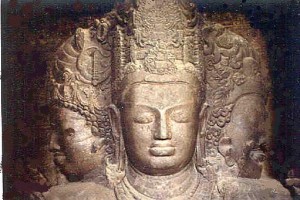
Figure 6 Trimurti (Triple God) at Temple in Ellora
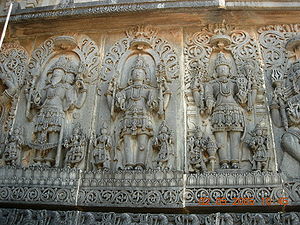
Figure 7 Trimurti at Temple in Elefanta
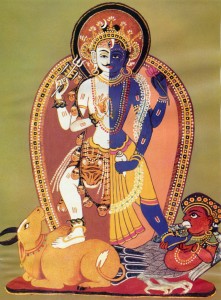
Figure 8 Hari Hara: Combining the Attributes of Shiva and Vishnu
Ten Incarnations (Desavataram) of Vishnu
NOTE: This gloss draws on several versions of the Desavaratam that provide a modern softening of the legends. Many do not cite the puranas with their elaborate descriptions of couplings, violence, multiple births, grisly murders, and embedded moral sanctions that are highly orthodox. This includes the condemnation of Varaha for having sex with a menstrual woman, Narasimha for vividly disemboweling his enemy, Parushuram who axes his own mother among others, or the fact that some early puranas were trenchantly anti-Buddhist and viewed the 9th incarnation as a misleading spiritual path whose followers were annihilated later by Kalki. Even the virtuous king Rama fights a long war to free his wife from the demon king Ravanna, but having her he informs her that he did it only for his own pride; he then condemns her to immolation because she cannot have lived in the house of another man without taint. She burns to prove her innocence (see Doniger, 174-237 for translations of these puranas). In short, these ancient documents reflect a moral fundamentalism that is under reflection by modern interpreters.
CREATION AND ESTABLISHMENT OF THE WORLD/VANQUISHING DEMONS
Traditional location of the Avatars by their cosmic epoch or yuga:
Satya/Krita Yuga: Matsyendra, Koorma,Varaha, Narasimha (animal or half-human manifestations)
Treta Yuga: Vaman, Parashuram, Rama (human manifestations)
Dwapara Yuga: Krishna, Buddha (spiritual forms)
Kali: Kalki (divine forms)
Matsya (fish)
Takes a king to the new world saving the earth’s species from a cyclone
Koorma (tortoise)
Rises from the sea to support the mountain that (Mandara, or Meru) that supports the demigods churning the seas for the nectar of immortality.
Varaha (boar)
Appears to defeat the demon Hiranyaksha who held the earth captive at the bottom of the sea.
Narasimha (man/lion)
Half-man, half-lion kills and disembowels the enchanted Hiranyakashipu (brother of Hiranyaksha) who was enchanted by Brahma and could not be killed by man.
FIRST HUMAN FORMS
Vaman (dwarf) [identified with the 7th age of Treta Yuga]
Tricks the powerful king into giving him “three steps” of the world, expanding to an enormous height whose three steps include the earth, the heaven, and finally Bali himself.
Parashuram (man with axe)
A Brahmin (in Treta Yuga) who learned warfare. May also symbolize first weapons and forest dwelling.
SPIRITUAL FORMS
Rama (moral man)
In Treta Yuga, the Golden Age. Protector of villages and settlements in development of humankind into communities. Saves his wife Sita from the king Ravanna with the aid of the monkey-god Hanuman. Unfortunately, Sita later walks into fire to prove her virtue while in captivity (and became the symbol of the “suttee,” the practice outlawed by the British in 1937) of a widow throwing herself (or being thrown) on her husband’s funeral pyre.
Sri Krishna (teacher of Arjuna/philosopher). Usually associated with the end of Dwapara
Yuga; his leaving is the beginning of Kali Yuga
Appears to teach the dharma, particularly karma yoga, and the practice of meditation and enlightenment, to Arjuna.
Buddha (spiritual) Appears during Dwapara Yuga
Although not claimed by the Brahmins in the Hindu tradition, one interpretation is that Vishnu appears as a Buddha to teach spiritual practice and enlightenment. He is also associated with the period of domestication of animals and advance of human civilization.
Kalki (avenger/cleanser). Manifests to end Kali Yuga and initiate a new Krita/Sat Yuga
Returns a tenth time to cleanse the earth and “restore purity.”
[Note: A core reference here is Doniger (1978, Chapter V, 175-237), which is a classic and sober treatment. However, in a classic of internet plagiarism, I have also consulted various sources available on the web. This is a précis based on a number of sites and other references; the images are also readily available on the web. In the case of both text and images precise attribution is difficult in the flowing stream of the web.]
Some Bibliography
There are many sources on the web from analytical to devotional to popular commentary. Those are easily available to anyone with a web browser. Less common is the older tradition of analysis by cultural anthropologists, specialists in Hindu philosophy and Sanskrit literature, and comparative religionists. These are typically Westerners steeped in Eastern literature and spiritual practice, but bringing a somewhat Western academic perspective to Hindu cosmology.
The “academic” literature is just that – the application of Western minds to Eastern religion in a non-apocalyptic way.
Easwaran, Eknath, The Bhagavad Gita. Tomales, CA: Nilgiri Press, 1999.
Eliade, Mircea. Yoga: Immortality and Freedom. Princeton: Princeton University Press, 1958.
Embree, Ainslie. Ed. The Hindu Tradition. New York: Vintage/Random House, 1972.
Feuerstein, Georg. The Deeper Dimension of Yoga; Theory and Practice. Boston: Shambhala,
2003.
Feuerstein, Georg. The Yoga Tradition: Its History, Literature, Philosophy and Practice.
Prescott, AZ: Hohm Press, 1998.
Hatha Yoga Pradipika. With commentary by Swami Muktibodhananda. Bihar, India: Yoga
Publications Trust, 2000)
O’Flaherty, Wendy Doniger. Hindu Myths. London: Penguin, 1975.
Zimmer, Heinrich (ed. Joseph Campbell). Myths and Symbols in Indian Art and Civilization.
Princeton: Princeton University Press, 1946.
Zimmer, Heinrich. Philosophies of India (ed. Joseph Campbell). Princeton: Princeton
University Press, 1951.
http://en.wikipedia.org/wiki/Kali_Yuga
ENDNOTES
(1) How Jesus Became God by Bart D. Ehrman (2014) examines these historical perspectives from the point of view from the theological field of what he calls “Christology.”
(2) Thoreau and others objected to the implication that waging war was a duty like all others and found uneasiness that Krishna seemed to be counseling war. There is a long philosophical discussion about this, with many of us choosing to focus on the deeper teaching karma yoga (right action without attachment to the consequences) and the nature of the enlightened person. Since my focus here is on mythochronology, these spiritual debates are bracketed out for moment to focus on what the Bhagavad Gita tells us about Kali Yuga.
(3) By the way, the Vishnu/Krishna is in the realm of Vishnaivaism which emphasizes that god over the others in the Trimurti, or three-faced deity. The Trimurti includes, broadly speaking, Brahman the creator, Shiva the destroyer (also lord of the dance and of yoga), and Vishnu who is the preserver and sustainer of the worlds and of humankind. It is in this role that he appears to Arjuna, and in all of his ten avatars.
(4) There are varying interpretations of this representation, but most include these basic elements: The horses are the indriyas or senses which are to be guided through the reins (manas, or mind). Krishna’s spiritual instruction to Arjuna guides him through sensory control, discriminative intelligence and concentration of the deeper self — ultimately to realization of the soul (atma).
(5) Some scholars in the Bahai faith give a different chronology. They have disputed the common Hindu chronology and re-calculated the dating of the eons. They may accept the belief that Vishnu will return, but disagree on when that is to happen. According to one the tenth incarnation of Vishnu has already happened. Some date the appearance of Vishnu as Kalki to 1844 when Baha’u’llah, the founding sage of the Bahai faith, was born. He is said to have brought an end to the dark epoch of Kali Yuga and brought the beginning a new Golden Age (Krita, or Sat, Yuga). This belief rests on an elaborate argumentation about Hindu chronology and a scientific effort in astronomy and archeology.
According to another chronology (Wikipedia) humankind is currently in a Golden period that began 5000 years after the beginning of Kali Yuga. According to that calculation, 5115 years have elapsed (as of 2013) since the 3102 BC date when Krishna left this world. By that calculation, the 5000 years of the first dark phase were complete in 1898, and a Golden era began in that year. This is not the orthodox interpretation of the Hindu chronology, but it is consistent with a more subtle theory of “cycles within cycles.”
Feuerstein (Deeper Dimension, pp. 177-184) describes some other variations on those of the Hindu ”mythochronologers”) . Some Western astrologers believe in the Age of Aquarius that with the passage of the equinoxes through the constellation of Aquarius in 1948. Others believe that the Mayan calendar confirms prophecies of Kali Yuga”), and fits roughly with other theories of “end times” with flaming battles between good and evil, and theories of destruction/rebirth.
(6) Some archeological seems to support Easwaran’s guess based on the dating of the lost city of Dvaraka which, according to the Mahabharata, sank into the sea when Krishna left the human world. The date of the city’s destruction is believed to be important to establishing the historical and cosmological legends, and is continually debated. Many websites devoted to this story feature photos of archeological divers investigating the submerged city. There is also an intersection between archeology and religious text in the Ramayana, the chronicle of King Rama’s battle to rescue his abducted wife Site from the demon king Ravanna. To reach Ravanna on what today is Sri Lanka the soldiers of the monkey-king Hanuman built a stone bridge from the tip of India to island. There is indeed a submerged chain of stones and land between India and Sri Lanka (easily visible from satellite, a modern confluence of myth and technology) – evidence, to some, that the Ramayana legend was historical fact. King Rama is known in legend as the 7th incarnation of Krishna, having materialized on earth eons before his appearance as Krishna in the Bhagavad Gita.
(7) In the Stephen Mitchell’s (p. 73) interpretation the statement is translated as:
Whenever righteousness falters
and chaos threatens to prevail
I take a human body
and manifest myself on earth.
In order to protect the good
to destroy the doers of evil
to ensure the triumph of righteousness,
in every age I am born.
This translation removes the words like maya and dharma that may be less familiar to Western readers. It gains fluidity for English speakers, but may lose a certain connection with these Eastern spiritual concepts.
(8) There are a total of ten incarnations, or avatars, of Vishnu. One of them has not yet appeared. Just before the onset of the Kali Yuga, the 8th avatar of Vishnu known as Krishna appears as the charioteer and mentor of the warriors Arjuna (Bhagavad Gita). Vishnu’s disappearance from material form coincides with the beginning of the Dark Age. The 10th avatar of Vishnu is Kalki Avatar, the warrior who restores moral order to the world and brings an end to Kali Yuga. In some exegeses, the 9th avatar is known as the Buddha (the “Awakened One”). There is disagreement about whether this is Gautama the Buddha, but at least one commentator (Feuerstein, Yoga Tradition, pp. 114-115) is convinced that this was the intention of the Brahmins who developed the doctrine of the ten incarnations. This might be seen as one of the dialogues between yoga and Buddhism, in this case coopting Gautama Buddha into Vishnaivite worship. There are many other examples of such interaction between yoga and Buddhism, as in portions Sutras of Patanjali. There the Brahmaviharas (elements of the “immeasurable mind”) are identical with the Buddhist dharma. In addition, the universal moral precepts of yoga (called yamas) are nearly identical with the exception of the more tolerant yogi attitude toward intoxicants.
(9) The figure of Shiva is sometimes portrayed in his attribute of destroyer, as in the South Indian bronzes of Shiva Nataranja, the cosmic dancer. Shiva dances in a halo of flames that seems to represent his annihilate the universe at the end of the present cycle of time. The cosmic dancer has many meanings, which may be the destruction at the end of the dark age of Kali Yoga, or even for “nature’s dance,” energy, the light of truth, or even the symbol/sound of OM. In many he dances with his hands in the abhaya mudra which offers both protection and peace.” Sometimes he is dancing on Apasmara Purusha, a man or demon that symbolizes forgetfulness, heedlessness, and ignorance. (Zimmer, Myths…, p. 151ff).
(10) Some also suggest that these cycles are analogous to the fierce Indian climate — from rich and productive weather to oppressive heat and parched earth.
(11) According to Embree (p. 209) the Puranas are “sectarian texts” that are identified with a particular god or deity. Many may have come from the early Christian era or earlier, but are dated in their final form from about 300 A. D., with some added as late as the 12th century. The Vishnu Puranas are texts by worshippers of Vishnu (Vishnaivites) and will vary from the Shivaite texts that focus on the role of Shiva the destroyer ).
(12) Our social action is another matter. Each of must engage in the social structure of our practice in a way that promotes our social values, even if this means contention within the yoga community about matters of social justice and hierarchy. I am only saying here that most of us find it helpful to temporally separate our individual experience on the mat (in posture, meditation or breath work) from the politics of the yoga community.
(13) Most modern hatha yogis have no need of a cosmology or a theology in order to carry on a productive physical and spiritual practice. This is a consequence of Westernization of yoga practice, but has an even longer tradition in India where thousands of years of discourse have generated yoga forms that are theistic, agnostic, atheistic, dualist, non-dualist, and varieties of transcendental. “Yoga” is a big tent, as they say, and saying just that word may have mixed associations for Indians and Westerners alike, but no discussion makes sense unless we ask simply: “What is your practice?” And, perhaps, “what beliefs are necessary for this practice.”
Recently a California jurisdiction considered a ban on yoga in public schools because of concerns that it established religion, or contravened the beliefs of a religious majority in the school district. An ivy-league academic of mixed academic qualifications and conservative Christian sponsorship made the case against yoga relying on the sutras of Patanjali. These 2500 year-old aphorisms codify yoga. They are understood by some (or many) to be dualistic – positing separate individual and supreme souls, and theistic – accepting a supreme being. What is often lost in the discussion is that there is a strong counterargument that no particular supreme being is mentioned and that a polymorphous term like “higher power” could easily be substituted (with all the polyvalences that this term can take). Although the sutras are grounded in the broad matrix of Indian spiritual thought, Patanjali’s codification is primarily about clarity, enlightenment, spiritual attainment, and the practice that supports this process. It is not even primarily about physical practice (having only four sutras on asana), but includes moral injunctions, norms of personal conduct, postures, breath work, and an ascending order of sensory restraint and meditation. Of the eight limbs of this classic yoga, none requires a supreme being or theological belief. But not all Americans, or even Indians, agree; this element is often a sticking point for hatha yogis, though, and at some point in their practice we all decide how to navigate (or bracket out) these classic issues.
The Encinatas, California court case found against the conservative critics and did not ban yoga as a religious transgression. But even in India the discussion occurs, as when an Indian school system tried to initiate yoga and secular critics feared that it would smuggle in concepts from theological Hinduism or this or that guru.
As noted earlier, the Sutras of Patanjali, which date from roughly a half century B.C.E only rarely mention a supreme being. Devotion to a higher power is mentioned in a few places (e.g., in Pada II: 1, and 2), but these are ambiguously translated and interpreted. Patanjali may have been writing in the tradition known as “Dwaita,” dualism of body and spirit, or of individual and a supreme being. But the more common interpretation is non-theist. Its dualism (Dwaita) is generally understood to be in the central feature of Atman, the soul, which is within each. These are the ‘large selves” within each of us, obscured by our “small selves” that are the outer surface of our being and characterized by ignorance, delusion and ego. There have also been “Adwaita” interpretations of yoga that interpret the individual soul as part of transcendent soul and see all as one. As one swami in that tradition says, “You are a cell in the mind of God.”
(14) In the words attributed to Vajryana Buddhist Sakya Pandita:
“Even if one were to die first thing tomorrow, today one must study. Although one may not become a sage in this life, knowledge is firmly accumulated for future lives, just as secured assets can be used later.” (cited in Feuerstein, Deeper Dimension…” p.69)
Though this is expressed in the language of multiple lives in time, we can also interpret this more softly (divorced from a belief in reincarnation) to apply to the continual rebirth that we all experience through practice in this life.